- 6 Sided Dice probability (worked example for two dice).
- Two (6-sided) dice roll probability table
- Single die roll probability tables.
To learn more watch the video below or keep reading.
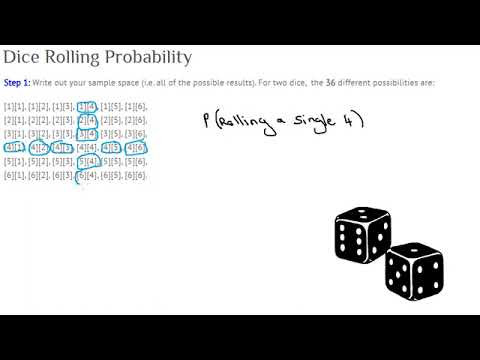
Can’t see the video? Click here to watch it on YouTube.
Dice roll probability: 6 Sided Dice Example
It’s very common to find questions about dice rolling in probability and statistics. You might be asked the probability of rolling a variety of results for a 6 Sided Dice: five and a seven, a double twelve, or a double-six. While you *could* technically use a formula or two (like a combinations formula), you really have to understand each number that goes into the formula; and that’s not always simple. By far the easiest (visual) way to solve these types of problems (ones that involve finding the probability of rolling a certain combination or set of numbers) is by writing out a sample space.
Dice Roll Probability for 6 Sided Dice: Sample Spaces
A sample space is just the set of all possible results. In simple terms, you have to figure out every possibility for what might happen. With dice rolling, your sample space is going to be every possible dice roll.
Example question: What is the probability of rolling a 4 or 7 for two 6 sided dice?
In order to know what the odds are of rolling a 4 or a 7 from a set of two dice, you first need to find out all the possible combinations. You could roll a double one [1][1], or a one and a two [1][2]. In fact, there are 36 possible combinations.
Dice Rolling Probability: Steps
Step 1: Write out your sample space (i.e. all of the possible results). For two dice, the 36 different possibilities are:
[1][1], [1][2], [1][3], [1][4], [1][5], [1][6],
[2][1], [2][2], [2][3], [2][4], [2][5], [2][6],
[3][1], [3][2], [3][3], [3][4], [3][5], [3][6],
[4][1], [4][2], [4][3], [4][4], [4][5], [4][6],
[5][1], [5][2], [5][3], [5][4], [5][5], [5][6],
[6][1], [6][2], [6][3], [6][4], [6][5], [6][6].
Step 2: Look at your sample space and find how many add up to 4 or 7 (because we’re looking for the probability of rolling one of those numbers). The rolls that add up to 4 or 7 are in bold:
[1][1], [1][2], [1][3], [1][4], [1][5], [1][6],
[2][1], [2][2], [2][3], [2][4],[2][5], [2][6],
[3][1], [3][2], [3][3], [3][4], [3][5], [3][6],
[4][1], [4][2], [4][3], [4][4], [4][5], [4][6],
[5][1], [5][2], [5][3], [5][4], [5][5], [5][6],
[6][1], [6][2], [6][3], [6][4], [6][5], [6][6].
There are 9 possible combinations.
Step 3: Take the answer from step 2, and divide it by the size of your total sample space from step 1. What I mean by the “size of your sample space” is just all of the possible combinations you listed. In this case, Step 1 had 36 possibilities, so:
9 / 36 = .25
You’re done!
Back to top
Two (6-sided) dice roll probability table
The following table shows the probabilities for rolling a certain number with a two-dice roll. If you want the probabilities of rolling a set of numbers (e.g. a 4 and 7, or 5 and 6), add the probabilities from the table together. For example, if you wanted to know the probability of rolling a 4, or a 7:
3/36 + 6/36 = 9/36.
Roll a…Probability
| 2 | 1/36 (2.778%) |
| 3 | 2/36 (5.556%) |
| 4 | 3/36 (8.333%) |
| 5 | 4/36 (11.111%) |
| 6 | 5/36 (13.889%) |
| 7 | 6/36 (16.667%) |
| 8 | 5/36 (13.889%) |
| 9 | 4/36 (11.111%) |
| 10 | 3/36 (8.333%) |
| 11 | 2/36 (5.556%) |
| 12 | 1/36 (2.778%) |
Probability of rolling a certain number or less for two 6-sided dice.
Roll a…Probability
| 2 | 1/36 (2.778%) |
| 3 | 3/36 (8.333%) |
| 4 | 6/36 (16.667%) |
| 5 | 10/36 (27.778%) |
| 6 | 15/36 (41.667%) |
| 7 | 21/36 (58.333%) |
| 8 | 26/36 (72.222%) |
| 9 | 30/36 (83.333%) |
| 10 | 33/36 (91.667%) |
| 11 | 35/36 (97.222%) |
| 12 | 36/36 (100%) |
Dice Roll Probability Tables
Contents:
1. Probability of a certain number (e.g. roll a 5).
2. Probability of rolling a certain number or less (e.g. roll a 5 or less).
3. Probability of rolling less than a certain number (e.g. roll less than a 5).
4. Probability of rolling a certain number or more (e.g. roll a 5 or more).
5. Probability of rolling more than a certain number (e.g. roll more than a 5).
Probability of a certain number with a Single Die.
Roll a…Probability
| 1 | 1/6 (16.667%) |
| 2 | 1/6 (16.667%) |
| 3 | 1/6 (16.667%) |
| 4 | 1/6 (16.667%) |
| 5 | 1/6 (16.667%) |
| 6 | 1/6 (16.667%) |
Probability of rolling a certain number or less with one die
.
Roll a…or lessProbability
| 1 | 1/6 (16.667%) |
| 2 | 2/6 (33.333%) |
| 3 | 3/6 (50.000%) |
| 4 | 4/6 (66.667%) |
| 5 | 5/6 (83.333%) |
| 6 | 6/6 (100%) |
Probability of rolling less than certain number with one die
.
Roll less than a…Probability
| 1 | 0/6 (0%) |
| 2 | 1/6 (16.667%) |
| 3 | 2/6 (33.33%) |
| 4 | 3/6 (50%) |
| 5 | 4/6 (66.667%) |
| 6 | 5/6 (83.33%) |
Probability of rolling a certain number or more.
Roll a…or moreProbability
| 1 | 6/6(100%) |
| 2 | 5/6 (83.333%) |
| 3 | 4/6 (66.667%) |
| 4 | 3/6 (50%) |
| 5 | 2/6 (33.333%) |
| 6 | 1/6 (16.667%) |
Probability of rolling more than a certain number (e.g. roll more than a 5).
Roll more than a…Probability
| 1 | 5/6(83.33%) |
| 2 | 4/6 (66.67%) |
| 3 | 3/6 (50%) |
| 4 | 2/6 (33.334%) |
| 5 | 1/6 (16.67%) |
| 6 | 0/6 (0%) |
Visit out our statistics YouTube channel for hundreds of probability and statistics help videos!
References
Dodge, Y. (2008). The Concise Encyclopedia of Statistics. Springer.
Gonick, L. (1993). The Cartoon Guide to Statistics. HarperPerennial.
Salkind, N. (2016). Statistics for People Who (Think They) Hate Statistics: Using Microsoft Excel 4th Edition.