Discrete vs continuous variables in a nutshell
Watch the video for an overview on discrete vs continuous variables:
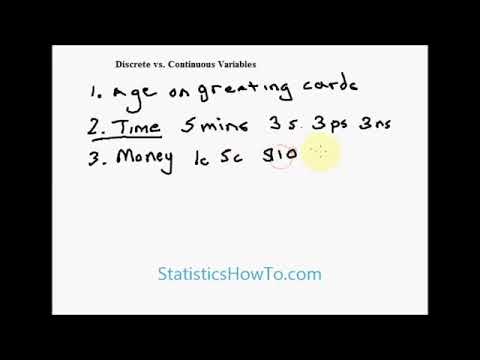
Can’t see the video? Click here to watch it on YouTube.
In an introductory stats class, one of the first things you’ll learn is the difference between discrete vs continuous variables. Discrete variables are countable, distinct values such as number of letters in a word or number of traffic accidents in a day. On the other hand, continuous variables are uncountable, infinite data such as distance, weight or time. Typically, continuous variables are measured instead of counted.
| Attribute | Discrete variables | Continuous variables |
|---|---|---|
| Number of values | Finite | Infinite |
| Type of data | Usually integers [1] | Any data type, including fractions and decimal parts |
| Countable? | Yes | No |
| Examples | Number of heads in 10 coin flips, number of students in a class, number of stars in a galaxy | Height, weight, temperature, time, volume, speed, distance, pressure, energy, voltage |
| Probability distribution | Represented by a discrete probability distribution | Represented by a continuous probability distribution |
Discrete vs Continuous variables: Definitions.
1. Discrete Variables
Discrete variables can only take on a set number of values [2]. They are easily countable within a fixed timeframe. For example, you can count the change in your pocket. You can count the money in your bank account. You could also count the amount of money in everyone’s bank accounts. It might take you a long time to count that last item, but the point is—it’s still countable.
Discrete variables are often plotted on scatter charts.
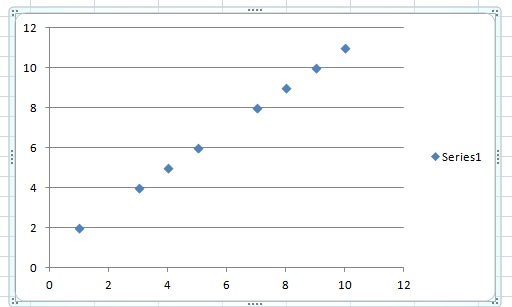
A few examples of discrete variables:
- Number of blue Skittles in a jar.
- Number of points made in a tennis match.
- Number of students in a class.
- Number of patients in a hospital.
- Number of times a coin lands on tails after ten coin tosses.
- Years of school.
- Votes for a certain politician.
While discrete variables typically take on integer values (1, 2, 3, …), they can also be a list of fractions. or decimals. For example, let’s say you made a list of the totals in your family banks accounts and get: $590.45, $6,301.32, $33.23, $878.12. These have fractional components, but they are countable and thus discrete.
2. Continuous Variables
Continuous variables can take on any value and any value between values [2]. They are practically uncountable. They include all fractional or decimal values within a range.
Examples of continuous variables include:
- Altitude of mountains.
- Body temperature of ICU patients.
- Distance from point A to point B.
- Time to run a marathon.
- Size of real estate lots.
- Speed of Formula One cars.
- Weight of giraffes.
While a continuous variable can, in theory take any value in an interval, we are usually limited by the precision of the measuring instrument [3]. For example, a person’s true weight might be 201.9387 kg., but we might only be able to measure it as 201.94 kg.
Continuous Variables would (literally) take forever to count. In fact, you would get to “forever” and never finish counting them. For example, take age. You can’t count “age”. Why not? Because it would literally take forever. For example, you could be: 25 years, 10 months, 2 days, 5 hours, 4 seconds, 4 milliseconds, 8 nanoseconds, 99 picosends…and so on.
You could turn age into a discrete variable and then you could count it. For example:
- A person’s age in years.
- A baby’s age in months.
Take a look at this article on orders of magnitude of time and you’ll see why time or age just isn’t countable. Try counting your age in Planctoseconds (good luck…see you at the end of time!).
Treating discrete variables as continuous variables
You cannot count someone’s exact age because counting in the smallest unit of time — a zeptosecond — would take forever. therefore, it is a continuous variable. But we sometimes turn age into discrete variables — such as age in years — so that we can count it. However, age is still a continuous variable even if we count it approximately with discrete variables.
Discrete vs Continuous variables: Steps
Trying to figure out how to tell the difference between discrete vs continuous variables? Try these steps:
- Figure out how long it would take you to sit down and count out the possible values of your variable. For example, if your variable is “Temperature in Arizona,” how long would it take you to write every possible temperature? It would take you literally forever: 50°, 50.1°, 50.11°, 50.111°, 50.1111°, … If you start counting now and never, ever, ever finish (i.e. the numbers go on and on until infinity), you have what’s called a continuous variable. If your variable is “Number of Planets around a star,” then you can count all of the numbers out (there can’t be an infinite number of planets). That is a discrete variable.
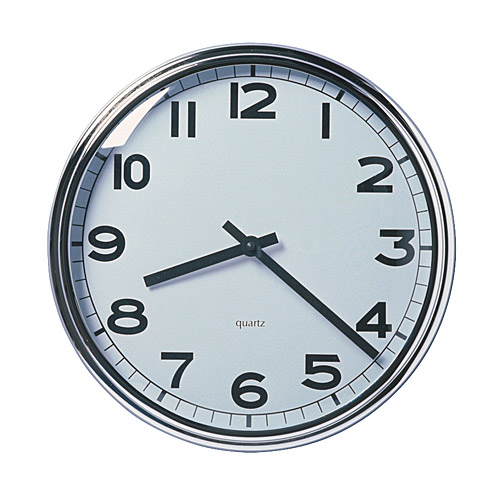
- Think about “hidden” numbers that you haven’t considered. For example: is time a discrete or continuous variable? You might think it’s continuous (after all, time goes on forever, right?) but if we’re thinking about numbers on a wristwatch (or a stop watch), those numbers are limited by the numbers or number of decimal places that a manufacturer has decided to put into the watch. It’s unlikely that you’ll be given an ambiguous question like this in your elementary stats class but it’s worth thinking about!
Check out our Youtube channel for more stats tips and help!
Discrete vs continuous variables: examples
Example question: Are the following variables discrete or continuous?
- Temperature in New York.
- Number of planets around a star.
- Numbers on a wristwatch.
- For “Temperature in New York,” how much time would it consume to write down every plausible — an exact — temperature? It would essentially take an infinite amount of time:
- 50°, 50.1°, 50.11°, 50.111°, 50.1111°, …
- If you start counting now and never stop (meaning the numbers continue endlessly into infinity), that means you have a continuous variable.
- In the case of “Number of Planets around a star,” it is possible to count all the planets, as the number of planets around any star is limited to thousands at most. This is a discrete variable.
- You may believe it is continuous (since time is infinite, right?), but when considering numbers on a wristwatch, those numbers are restricted by the manufacturer’s choice of which numbers or number of decimal places to include. Therefore, numbers on a wristwatch are discrete variables.