Probability and Statistics > Probability > Mutually Exclusive Events
What is a Mutually Exclusive Event?
Mutually exclusive events, in a single experiment, can’t happen at the same time. They are sometimes called disjoint events [1].
For example, you can’t pass a test and fail it at the same time. In other words, the events “passing a test” and “failing a test” are mutually exclusive. Other examples of mutually exclusive events include:
- Tossing a coin and getting a heads and tails.
- Drawing one card from a standard deck and getting a Jack and a Queen.
- Walking outside into snow and a desert sandstorm.
- Being approved for a visa and being denied.
- Getting married and getting divorced.
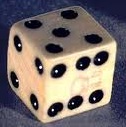
Complementary events are mutually exclusive. But, mutually exclusive events do not need to be complementary. For example, rolling a die once and getting a 1 or a 6 are mutually exclusive, because they cannot happen at the same time. But they are not complementary events, because there are other possible outcomes, such as 2, 3, 4, and 5 [2].
How do you know if A and B are mutually exclusive?
To answer that question, we’ll need a couple of formulas.
The probability of an event can be calculated with the formula:
P = Number of ways the event can happen / total number of outcomes.
For example, The probability of rolling a “6” when you toss a six-sided die is 1/6 because there is one die face numbered “6” and six possible outcomes (1, 2, 3, 4, 5, 6). If we call the probability of rolling a 6 “Event A”, then the formula becomes:
- P(A) = Number of ways the event “rolling a 6” can happen / total number of outcomes
- P(A) = 1 / 6.
If we wanted to write the probability for a separate event (say, rolling a two which we’ll call event “B”), then we can calculate that as well:
- P(B) = Number of ways the event “rolling a two” can happen / total number of outcomes
- P(B) = 1 / 6.
But mutually exclusive events — such as rolling a 6 and rolling a 1 — cannot happen at the same time. In mathematical terms, we can write that as
P(A and B) = 0.
When you roll a die, you can roll a 1 OR a 6 (the odds are 1 out of 6 for each event) and the sum of either event happening is the sum of both probabilities. In notation, it’s written like this:
- P(A or B) = P(A) + P(B)
- P(rolling a 1 or rolling a 6) = P(rolling a 5) + P(rolling a 6)
- P(rolling a 1 or rolling a 6) = ⅙ + ⅙ = 2/6 = ⅓.
We can use all of these facts in order to figure out if two events are mutually exclusive
Mutually Exclusive Event Probability: Example
Example problem: “If P(A) = 0.20, P(B) = 0.35 and (P A∪ B) = 0.51, are A and B mutually exclusive?”
Note: a union (∪) of two events occurring means that A or B occurs.
Step 1: Add up the probabilities of the separate events (A and B). In the above example: .20 + .35 = .55
Step 2: Compare your answer to the given “union” statement (A ∪ B). If they are the same, the events are mutually exclusive. If they are different, they are not mutually exclusive.
Why? If they are mutually exclusive (they can’t occur together), then the (∪)nion of the two events must be the sum of both, i.e. 0.20 + 0.35 = 0.55. In our example, 0.55 does not equal 0.51, so the events are not mutually exclusive.
Like the explanation? Check out more step by step examples—just like this one for mutually exclusive events—in the Practically Cheating Statistics Handbook
Mutually exclusive and independence
Mutually exclusive events and independent events are different concepts:
- Mutually exclusive events cannot happen simultaneously.
- Independent events do not influence each other’s probabilities. For example, if you flip a coin two times, the event of getting heads on the first flip does not affect the event of getting tails on the second flip.
So in order for an event to be mutually exclusive and independent, they
- Cannot happen at the same time
- Do not influence each other’s probability.
The event of rolling a die and getting a 1, or rolling a die and getting a 6, is both mutually exclusive (they can’t happen simultaneously) and independent (rolling a 1 doesn’t affect the next roll at all).
On the other hand, mutually exclusive dependent events are those that
- Cannot happen at the same time
- Influence each other’s probabilities.
For example, let’s say it’s a bingo game and you choose one ball from an urn full of 100 bingo balls. Each event (drawing a 1, drawing a 2, drawing a 3, …) is mutually exclusive as you can only draw one ball. But let’s say you draw the 66 ball (odds of 1/100). In Bingo, you do not replace the balls, so when it comes to choosing the second ball, the odds drop to 1/99 — which means that the two events (choosing the first ball, choosing the second ball) are dependent.
References
-
Penn State. 2.1.3.2.1 – Disjoint & Independent Events
-
Cameron, A. 1 Dependent and Independent Events